
When Angels Fell
The Watchers, the Nephilim and the Book of Enoch
Four strange verses just before the flood explain why the flood came. In this shiur we hear the three classic answers, see how the Bible itself uses “sons of God,” meet Enoch and the Watchers of Mount Hermon, and learn what Yeshua meant when He said the last days will be like the days of Noah.









The strangest four verses in the Torah
Just before the story of Noach and the ark, the Torah tells a story so strange that many people skip right over it:
“When people began to multiply on the face of the earth, and daughters were born to them, the sons of God saw that the daughters of men were beautiful, and they took as wives any they chose. Then Hashem said, ‘My Spirit will not contend with man forever, for he is flesh; his days will be one hundred and twenty years.’ The Nephilim were on the earth in those days, and also afterward, when the sons of God came to the daughters of men and they bore children to them. These were the mighty men of old, the men of renown” (Genesis 6:1–4).
Right after this, the Torah says: “God saw that the wickedness of man was great on the earth, and that every intention of the thoughts of his heart was only evil all the time” (6:5). And then comes the flood.
So these four verses are not a side story. They explain why the flood came. If we want to understand the days of Noach, and Yeshua said the last days will be “like the days of Noah” (Matthew 24:37), we have to understand what happened here. Who were the “sons of God”? And who were the Nephilim?

Three answers
There are three main answers to this question.
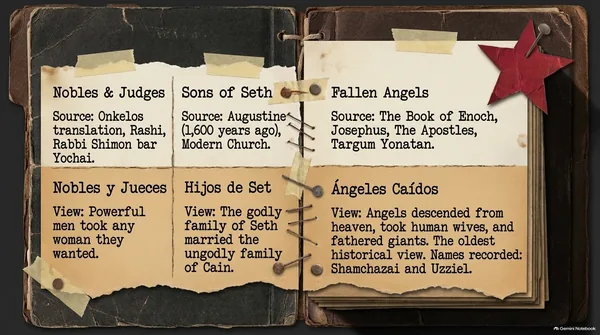
Answer one: sons of judges and nobles. The Aramaic translation of Onkelos calls them bnei ravrevaya, “the sons of the great ones.” Rashi agrees:
“The sons of God”: the sons of the princes and the judges. (Rashi on Genesis 6:2)
In this view, powerful men took any woman they wanted, and no one could stop them. The Midrash records that Rabbi Shimon bar Yochai held this view so strongly that he cursed anyone who called them “sons of God” in the sense of angels (Bereshit Rabbah 26:5).
Answer two: the sons of Seth. This is the most popular view in churches today. It goes back to Augustine, about 1,600 years ago. He taught that the “sons of God” were the godly family of Seth, and the “daughters of men” were the ungodly family of Cain. When the good family married into the bad family, the whole world went bad.
Answer three: angels. This is the oldest view of all. The ancient Book of Enoch, written before the time of Yeshua, says the “sons of God” were angels who came down from heaven and married human women. Their children were the Nephilim, the giants. Josephus, the Jewish historian of the first century, wrote that “many angels of God” took wives and fathered sons who trusted in their own strength (Antiquities 1.73). Some of the oldest copies of the Greek translation of the Torah actually read “the angels of God saw the daughters of men” in Genesis 6:2. And the Aramaic Targum known as Targum Yonatan even gives two of the angels’ names:
Shamchazai and Uzziel fell from heaven, and they were on the earth in those days. (Targum Yonatan on Genesis 6:4)
The Talmud names them too. It explains that the goat sent “to Azazel” on Yom Kippur (Leviticus 16:8) brings atonement “for the deeds of Uza and Azael” (Yoma 67b), two angels who sinned. And the Talmud says the giant Og, king of Bashan, was a grandson of Shamchazai (Niddah 61a).
So which is it?
What does “sons of God” mean?
The best way to find out what a phrase means is to see how the Bible uses it somewhere else. The exact phrase bnei ha’Elohim, “the sons of God,” appears in only one other book of the Tanakh: the book of Job. And there it clearly means angels.
“One day the sons of God came to present themselves before Hashem, and Satan also came among them” (Job 1:6).
These “sons of God” are standing in Hashem’s heavenly court, and Satan is with them. They aren’t judges or the family of Seth. And later, Hashem asks Job:
“Where were you when I laid the foundations of the earth?… when the morning stars sang together, and all the sons of God shouted for joy?” (Job 38:4, 7).
The sons of God were cheering when the earth was created, before any human being existed. So in the Bible’s own language, “sons of God” means angels.

How could angels marry?
Here is the big objection. Yeshua said: “When they rise from the dead, they neither marry nor are given in marriage, but are like the angels in heaven” (Mark 12:25). Doesn’t that settle it?
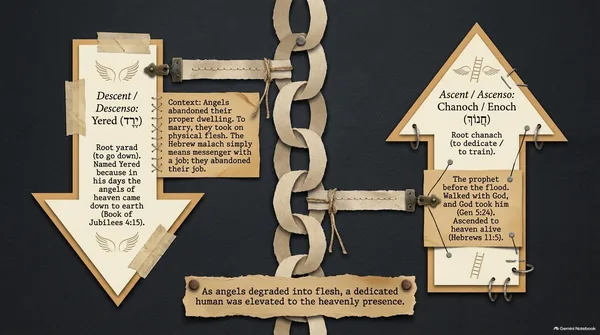
Look closely. Yeshua said angels in heaven don’t marry. He didn’t say angels are unable to. The ones in Genesis 6 didn’t stay in heaven. As we’ll see, the Brit Hadashah says they “abandoned their proper dwelling” (Jude 6).
And the Bible shows angels doing very physical things. Three angels visited Avraham, and he served them a meal. “And they ate” (Genesis 18:8). Two angels came to Sodom, and Lot “baked unleavened bread, and they ate” (19:3). The men of Sodom saw them as real men. Our sages explain what happened to the angels who fell:
The angels who fell from their holy place in heaven saw the daughters of Cain walking about … and they went astray after them. When they fell, their strength and stature became like that of the sons of men, and their bodies became like clods of earth. (Pirkei de-Rabbi Eliezer 22, adapted)
In other words, when they came down, they took on real flesh and blood. That’s how they could have children.

Enoch, the prophet before the flood
To understand this story, we need to meet a man who lived before it: Enoch, Chanoch in Hebrew. He was the seventh generation from Adam, and Noach’s great-grandfather.
“Enoch walked with God, and he was no more, for God took him” (Genesis 5:24).
Everyone else in Genesis 5 has the same ending: “and he died.” Not Enoch. He lived 365 years, one for each day of the solar year, and then he was simply gone. Our sages see this two ways.
Rashi says Enoch was righteous, but Hashem took him early before he could be led astray by his wicked generation (Rashi on Genesis 5:24). The Aramaic Targum Yonatan says something much bigger:
Enoch served in truth before Hashem, and behold, he was not with the inhabitants of the earth, for he was taken away and ascended to heaven by the Word before Hashem. (Targum Yonatan on Genesis 5:24)
The Brit Hadashah agrees with the Targum: “By faith Enoch was taken up so that he would not see death, and he was not found, because God had taken him. Before he was taken, he was commended as one who pleased God” (Hebrews 11:5). Enoch, like Eliyahu after him, went up alive. The two views fit together. Enoch’s world was so wicked that Hashem took him out of it, not into the grave, but into His presence.
The Book of Enoch
Over the centuries, many Jewish writings grew up around Enoch. The most famous is called 1 Enoch, or the Book of Enoch. It was written in the generations before Yeshua. It isn’t part of the Jewish Tanakh, but it was widely read. Copies of it in Aramaic were found among the Dead Sea Scrolls, and the Zohar mentions the “Book of Enoch” again and again. The Ethiopian church still keeps it in its Bible today.
Most importantly, the Brit Hadashah quotes it. Jude writes:
“Enoch, the seventh from Adam, also prophesied about these people, saying, ‘Behold, the Lord comes with ten thousands of His holy ones, to execute judgment on all, and to convict all the ungodly of all their ungodly deeds’” (Jude 14–15).
That is almost word for word from 1 Enoch 1:9. Jude clearly read it and respected it. So did his readers.

The Watchers on Mount Hermon
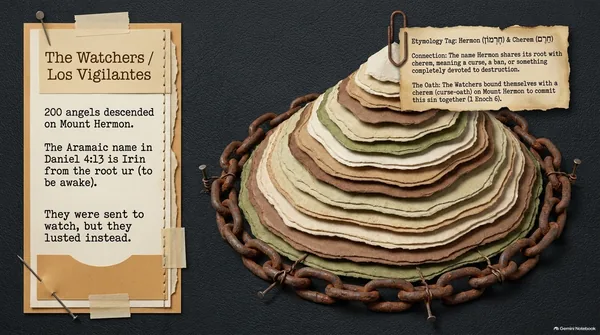
So what does the Book of Enoch say happened? It tells the story of a group of angels called the Watchers. The prophet Daniel uses the same name in Aramaic, irin: “a watcher, a holy one, came down from heaven” (Daniel 4:13). These angels were sent to watch over mankind.
According to Enoch, two hundred of the Watchers looked at the daughters of men and desired them. Their leader, Shemihazah (the same Shamchazai named in the Targum and Talmud), was afraid to go through with it alone. So they all came down together on top of Mount Hermon and swore an oath to one another (1 Enoch 6). Enoch even lists their leaders: twenty chiefs, each over ten angels. One taught men the signs of the stars, another taught them how to read omens in the sky.

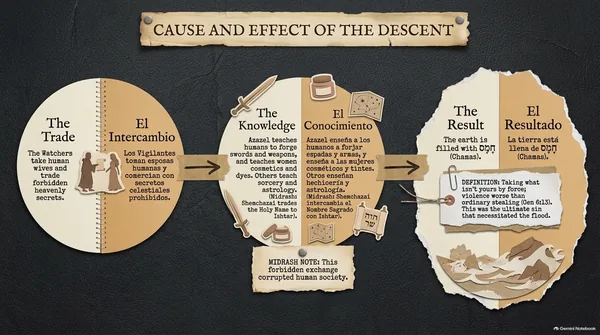
Then they took wives, and their children were the Nephilim, the giants. The giants ate up everything people had grown, and when the food ran out, they began to eat people. Meanwhile, the Watchers taught mankind forbidden secrets. Azazel taught men to make swords and weapons of war, and taught women jewelry, makeup and dyes. Others taught sorcery, spells and fortune-telling by the stars (1 Enoch 7–8). The earth filled with blood, and people cried out to heaven.
Doesn’t that sound like the Torah’s own description? “The earth was corrupt before God, and the earth was filled with violence… for all flesh had corrupted its way on the earth” (Genesis 6:11–12).
Our sages tell a very similar story. The Midrash says that when Hashem was about to create man, two angels, Shemchazai and Azael, objected: “What is man, that You are mindful of him?” (Psalm 8:4). Hashem answered that if they lived on earth with an evil inclination, they would do even worse. So they asked to go down and prove Him wrong:
Immediately they went down and corrupted themselves with the daughters of men. Shemchazai saw a girl named Istahar and desired her. She said, “I will not listen to you until you teach me the Holy Name by which you ascend to heaven.” He taught it to her, and she said it and rose up to heaven, and Hashem set her among the stars. When Shemchazai saw that the flood was coming, he repented. But Azael did not repent, and he still teaches women to paint their faces and lead men astray. That is why Israel sends the goat to Azazel on Yom Kippur. (Midrash of Shemchazai and Azael, Yalkut Shimoni, Bereshit 44, adapted)
Interesting: the girl’s name, Istahar, is the name of Ishtar, the goddess of the Babylonians.

Three generations of giants
The Torah gives the giants several names: Nephilim, Anakim (the sons of Anak) and Rephaim. “There we saw the Nephilim, the sons of Anak, who come from the Nephilim, and we seemed like grasshoppers in our own eyes” (Numbers 13:33).
Rabbi Efraim Palvanov suggests a fascinating way to read this: three generations. The Nephilim were the fallen angels themselves. Their children, half angel and half human, were the Anakim. Their grandchildren, a quarter angel, were the Rephaim, a word that can mean “the weak ones.” Each generation was smaller and weaker than the one before. And that’s exactly what the Talmud says about Og: he was the son of Achiah, the son of Shamchazai (Niddah 61a). Three generations from the fallen angel.
“Only Og king of Bashan was left of the remnant of the Rephaim. Look, his bed was a bed of iron… nine cubits long” (Deuteronomy 3:11). That’s a bed more than thirteen feet long!
And where did Og rule? “On Mount Hermon, in Salecah, and in all Bashan” (Joshua 12:5). The very mountain where the Watchers came down.
But wait. If the flood killed everything, how were there still giants afterward? The Torah itself hints at the answer: “The Nephilim were on the earth in those days, and also afterward” (Genesis 6:4). Our sages give several answers. One midrash says Og survived by holding on to the outside of the ark and promising to serve Noach and his sons (Pirkei de-Rabbi Eliezer 23). How ironic: the giants who wanted to rule over humans now begged to be their servants. Another view is that more angels fell after the flood. Either way, the Nephilim kept coming back, until Moshe, Yehoshua and David finished them off. Goliath and his brothers were among the last (2 Samuel 21:22).

What the Brit Hadashah says
Here’s what surprises many people. The apostles clearly knew the story of the Watchers.
Peter writes: “For God did not spare the angels when they sinned, but threw them down into Tartarus and committed them to chains of darkness, to be kept until the judgment. And He did not spare the ancient world, but protected Noah, a preacher of righteousness, with seven others, when He brought a flood on the world of the ungodly…” (2 Peter 2:4–5). Notice the order: first the angels that sinned, then the flood. That’s exactly the order in the Book of Enoch.
The word Peter uses here is Tartarus, the deepest prison in the Greek imagination. He’s not talking about the devil’s original rebellion. He’s talking about angels who are chained up right now, waiting for judgment.
Jude is even clearer: “And the angels who did not keep their own position, but abandoned their proper dwelling, He has kept in eternal chains under darkness for the judgment of the great day. In the same way, Sodom and Gomorrah and the cities around them, which likewise gave themselves over to immorality and went after strange flesh…” (Jude 6–7). These angels left their home. They are in chains. And Sodom sinned “likewise”: going after flesh that was not their own kind. That’s the Watchers.
And Peter mentions them once more: Messiah “went and proclaimed to the spirits in prison, who had once been disobedient, when God waited patiently in the days of Noah while the ark was being built” (1 Peter 3:19–20). Spirits in prison since the days of Noach. In the Book of Enoch, Enoch himself goes to announce Hashem’s judgment to the imprisoned Watchers (1 Enoch 13–16). Peter says Messiah went to announce His victory over them. And then Peter adds that Yeshua is “gone into heaven and is at the right hand of God, with angels, authorities and powers made subject to Him” (1 Peter 3:22).
So the popular Christian view of the “sons of Seth” has trouble explaining these verses. The apostles stand with the older Jewish reading. And so did the earliest believers after them, men like Justin Martyr and Irenaeus, who taught that the sons of God were angels. The “sons of Seth” view came later.
How do we harmonize all three answers? They may be closer than they look. The fallen angels used their power to make themselves rulers and judges, and their sons became the “mighty men of old, the men of renown,” the kings and warlords of the ancient world. So the angels became the “great ones” and “judges” that Onkelos and Rashi describe. And the line of Seth, the godly family, was swallowed up by this corruption until only Noach was left. Interestingly, the Zohar, which tradition attributes to the same Rabbi Shimon bar Yochai who rejected the angel reading, also teaches about the fallen angels Aza and Azael. All three answers describe the same world: a world where the boundaries Hashem set were broken.

Where did demons come from?
Here’s a question the Torah never answers directly: where do evil spirits come from? The Brit Hadashah is full of them. Yeshua cast out many. But Genesis never tells us how they started.
The ancient Book of Jubilees gives an answer. When the giants died in the flood, their spirits remained on the earth, homeless and evil. After the flood, they began to trouble Noach’s grandchildren. So Noach prayed:
You know how Your Watchers, the fathers of these spirits, acted in my days. Now shut up these spirits that are living, and hold them fast in the place of condemnation. Do not let them destroy the sons of Your servant. (Jubilees 10:5–6, adapted)
Hashem told His angels to bind them. But the chief of the evil spirits asked to keep some of them so he could test mankind. Hashem allowed one tenth to remain on earth and sent the other nine tenths to the place of judgment (Jubilees 10:7–9).
Whether or not every detail is true, it fits what the demons said to Yeshua: “What do You want with us, Yeshua, Son of God? Have You come here to torment us before the appointed time?” (Matthew 8:29). They know a day of judgment is coming. And they know Who will judge them.
The chains and the Abyss
In the Book of Enoch, Hashem sends His archangels to deal with the Watchers before the flood. Raphael binds Azazel hand and foot and throws him into a dark pit in the desert. Michael binds Shemihazah and his companions under the earth for seventy generations, until the day of judgment. And Hashem sends the archangel Uriel to Noach to warn him of the flood and tell him how to escape it (1 Enoch 10). That’s where the “chains of darkness” in Peter and Jude come from.
The book of Revelation picks up the same picture at the end of days. First, the Abyss, the bottomless pit, is opened for a short time, and its prisoners come out (Revelation 9:1–2). But then: “I saw an angel coming down from heaven, holding the key of the bottomless pit and a great chain in his hand. He seized the dragon, that ancient serpent, who is the Devil and Satan, and bound him for a thousand years” (Revelation 20:1–2).
Here’s something important. The Watchers and Satan are not the same. Satan is the accuser. He resented mankind from the beginning. The Watchers fell for a different reason: they desired what was forbidden. One fell through hatred, the other through lust. But in the end, both are chained in the same darkness. The same Hashem who judged the Watchers before the flood will judge the serpent at the end.

The gates of Hades
There’s one more place where this story shows up in the Gospels, though most people never notice it.
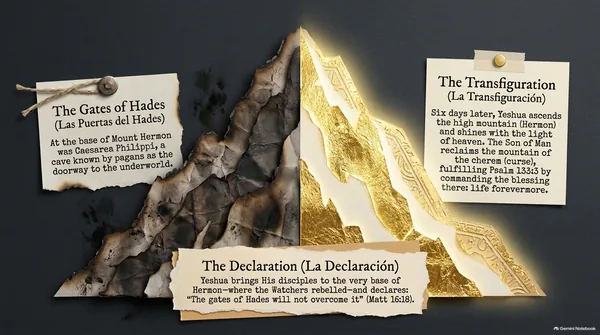
At the foot of Mount Hermon, in the far north of Israel, there was a city called Caesarea Philippi. It had a famous cave with a spring flowing out of it, where pagans worshiped the goat-god Pan. They called the cave “the gates of Hades,” the doorway to the underworld.
Guess where Yeshua took His disciples? To Caesarea Philippi. And there, at the foot of the mountain where the Watchers swore their oath, He said: “On this rock I will build My ekklesia, and the gates of Hades will not overcome it” (Matthew 16:18). Six days later, He took Peter, James and John “up a high mountain” and was transfigured before them, shining like the sun (17:1–2). Many believe that mountain was Hermon itself.
On the very mountain where the fallen angels came down in darkness, the Son of Man shone with the light of heaven. And King David had already sung about Hermon’s redemption: “It is like the dew of Hermon, which comes down on the mountains of Zion. For there Hashem commanded the blessing: life forevermore” (Psalm 133:3). The mountain of the curse will become the mountain of the blessing.

As in the days of Noach
So why does all of this matter to us?
Because Yeshua said: “As it was in the days of Noah, so it will be at the coming of the Son of Man” (Matthew 24:37). The days of Noach were days when the boundaries Hashem set were broken. Heaven and earth mixed in ways they never should have. Men learned secrets they were never meant to have, and used them for war, vanity and witchcraft. And the result was violence that filled the whole earth.
Does that sound familiar? Today, men are tampering with the very building blocks of life that Hashem made “according to its kind.” Our world is full of new technology, new weapons, and old sorcery dressed up in new clothes. And it is full of violence.

The giants died in the flood, but the Zohar teaches that their spirit lives on. When Israel left Egypt, a “mixed multitude” went up with them (Exodus 12:38), the erev rav. The Zohar says there are five kinds of this mixed multitude, and every one of them takes its name from the generations before and after the flood (Zohar 1:25a):
- The Nephilim, the “fallen ones,” whose root is in the fallen angels Aza and Azael. They give in to forbidden desires, and they are most dangerous when they pretend to be holy.
- The Giborim, the “mighty men… men of renown” (Genesis 6:4). They want to make a name for themselves, like the builders of Babel. They chase money, power and big buildings.
- The Rephaim, the “weak ones.” When they see Israel suffering, they shrug and do nothing.
- The Anakim, the “giants,” who twist the Torah upside down, making it either so heavy no one can carry it or so light it means nothing, until everything falls back into chaos.
- The Amalekim, whose root is in the chamas, the violence, of the generation of the flood. They side with Israel’s enemies.
Rabbi Efraim Palvanov points out that the Zohar is describing types of people we can still recognize today. And the warning isn’t only about “them.” Each of us has to ask: Am I chasing a name for myself? Do I care when my people suffer? Do I bend the Torah to fit what I want?
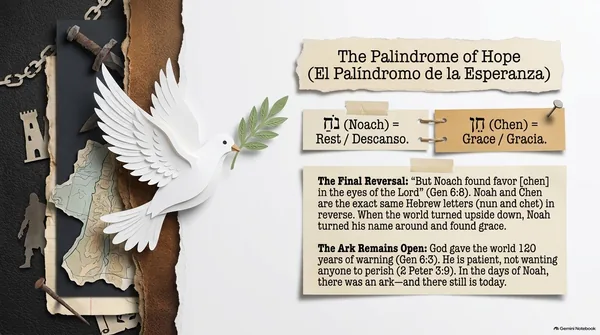
But here’s the good news. In the days of Noach, there was still a man who “found favor in the eyes of Hashem” (Genesis 6:8). There was still a righteous family. There was still an ark. And the fallen angels, the giants, and every evil spirit are already under the authority of the One who sits at Hashem’s right hand.

Hashem gave the world 120 years of warning (Genesis 6:3). He is patient. He is “patient toward you, not wanting anyone to perish, but everyone to come to repentance” (2 Peter 3:9). Next, we’ll step aboard the ark with Noach and see how Hashem saved the righteous and the animals through the waters.
Shabbat shalom.
Bible verses are in modern English, with Hashem for the Divine Name (LORD). Jewish sources are given in short translation or paraphrase. The Book of Enoch and Jubilees are ancient Jewish writings, quoted for what they show about how Jews read Genesis in the days of the apostles; they are not part of the Tanakh. A shiur for Shabbat Noach 5787 (October 17, 2026).